Xbox’s Q2 Win: Did PlayStation Help Microsoft More Than Sony?
Six of PlayStation's top 10 best-selling games in Q2 2025 were Microsoft-published, as Xbox's multi-platform strategy paid off.
Sometimes the console-war scoreboard is not the one fans expect. In 2026, looking back at the second quarter of 2025, one data set from Circana analyst Mat Piscatella still stands out: six of the ten best-selling games on PlayStation consoles in the United States from April through June 2025 were published by Microsoft. That is not a misprint. The company behind Xbox had a stronger presence on Sony’s platform than Sony itself did in the upper ranks of the software chart.
So who should be thanking whom? Is PlayStation carrying Xbox’s software business, or is Xbox quietly becoming one of PlayStation’s most valuable publishers? The answer is probably both, and that is what makes the quarter so fascinating.
📊 The PlayStation Chart Tells a Surprising Story
For the April-to-June 2025 window, the PlayStation top ten in the U.S. looked less like a Sony victory lap and more like a Microsoft showcase. Forza Horizon 5 debuted at No. 2 for the quarter, just behind Elden Ring Nightreign. The Elder Scrolls IV: Oblivion Remastered was right behind it. Doom: The Dark Ages debuted at No. 6, and Indiana Jones and the Great Circle came in at No. 8.
Returning titles filled out the Microsoft side of the chart: Call of Duty: Black Ops 6 and Minecraft both remained popular. Sony, by contrast, had only two first-party games in the top ten: MLB: The Show 25 and Death Stranding 2: On the Beach, which debuted at No. 7.
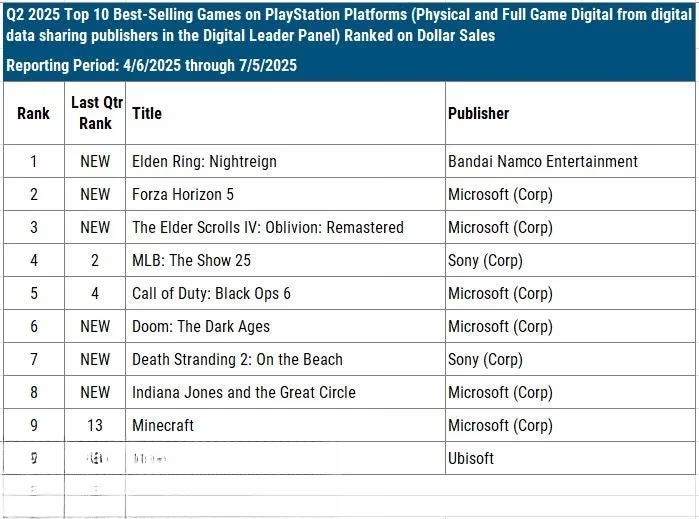
That split is striking. PlayStation is often treated as the default home for premium single-player games, yet during this quarter Microsoft-published software was everywhere on Sony’s console. The result raises a simple but uncomfortable question: if Microsoft is publishing so many of the best-selling games on PlayStation, is the traditional console rivalry still the right way to understand the business?
💰 Xbox Earnings Back Up the Software Story
The chart data arrived alongside Xbox’s Q2 earnings, and the numbers explained why Microsoft might not be too worried about losing exclusive bragging rights. Gaming revenue rose 10% year-over-year, while Xbox content and services revenue climbed 13%. That growth was driven by first-party content and Xbox Game Pass. Hardware revenue, however, declined 22% year-over-year.
In other words, Microsoft is making more money from games and subscriptions even as console sales struggle. A multi-platform strategy suddenly looks less like a surrender and more like a calculated play. If a game can sell on PlayStation, PC, and Xbox while also feeding Game Pass, the old exclusive-only model starts to look limiting.
🎮 The Xbox Chart Looks Different for a Reason
Notably, the top ten games on Xbox last quarter looked a bit different. Oblivion: Remastered still took a spot all the way up at No. 2. The Elder Scrolls Online also ranked high, followed by Minecraft at No. 4. Call of Duty: Black Ops 6 showed up at No. 9.
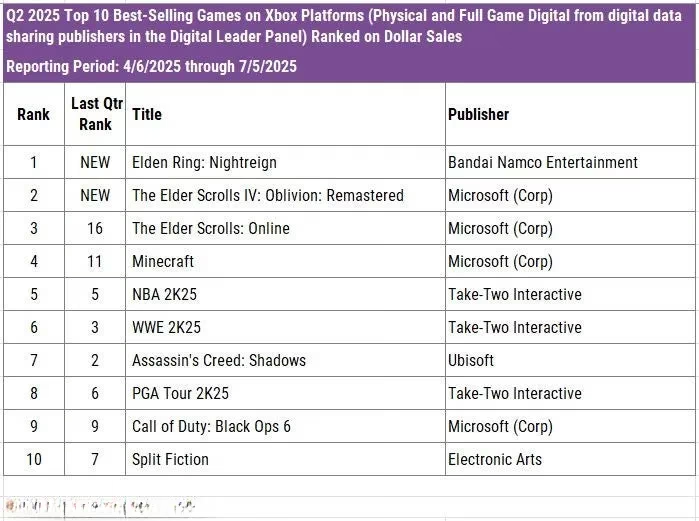
But Indiana Jones and Doom did not rank on Xbox, likely because both launched into Game Pass. Oblivion did as well, which makes its high placement even more impressive. Forza Horizon 5 also was not present on the Xbox chart, though that is more likely because it originally released on Xbox back in 2021. Its PlayStation debut in April 2025 made it feel new to a different audience.
This contrast matters. Game Pass can cannibalize traditional sales on Xbox, but it can also build buzz that carries over to other platforms. A player who tries a game through a subscription might later buy it on PlayStation, or vice versa. The old walls between ecosystems are becoming more porous.
🤔 So Who Really Won the Quarter?
Microsoft can point to revenue growth, a strong PlayStation chart presence, and a subscription service that keeps players engaged. Sony can point to its own first-party hits and a massive installed base that attracts publishers like Microsoft. Players, meanwhile, get more games in more places.
Yet the celebration may be short-lived if Microsoft cannot keep new games coming. The company has recently laid off hundreds of workers and canceled multiple projects, including Everwild and Perfect Dark. Those decisions could create a content gap in the years ahead. In 2026, the industry is still watching to see whether those cancellations will hurt the pipeline that made Q2 2025 so strong.
That is the real test. Can Xbox continue to supply PlayStation with best-sellers while also supporting Game Pass and its own hardware? Or will the multi-platform strategy eventually expose a shortage of new exclusive-style experiences? For now, the Q2 2025 data suggests Microsoft’s bet is working. The next few years will reveal whether it is sustainable.
One thing is clear: the console war is no longer a simple story of Xbox versus PlayStation. It is a tangled web of publishing, subscriptions, hardware, and software sales. And sometimes, the biggest winner on PlayStation is the company that makes Xbox. 🎯