Why Baldur's Gate 4 Should Embrace the Red Wizards of Thay
Baldur's Gate 4 should ditch the city and plunge into the Red Wizards of Thay's necromantic civil war for richer moral complexity.
Larian Studios gambled on the mind flayers, the Dead Three, and a cast of deeply troubled companions—and that gamble paid off spectacularly. Three years removed from Baldur's Gate 3's launch, the game still commands a remarkable presence in the RPG space, and the conversation has naturally turned to what comes next. Will a Baldur's Gate 4 ever materialize, and if so, what corner of the Forgotten Realms should it explore? I've been turning this question over for months, and one faction keeps clawing its way into my thoughts: the Red Wizards of Thay.
Before I dig into why they are perfect, let's level the obvious objection. Baldur's Gate 4 suggests a story tethered to the titular city, right? Not necessarily. The original duology already stretched beyond the city walls, and BG3 itself only flirted with the Gate for a single act, then whisked us off to cursed lands and astral realms. The franchise has earned the freedom to roam. And if we are seriously looking at fresh, morally complex soil, Thay offers a landscape that makes the Shadow-Cursed Lands look like a roadside picnic.
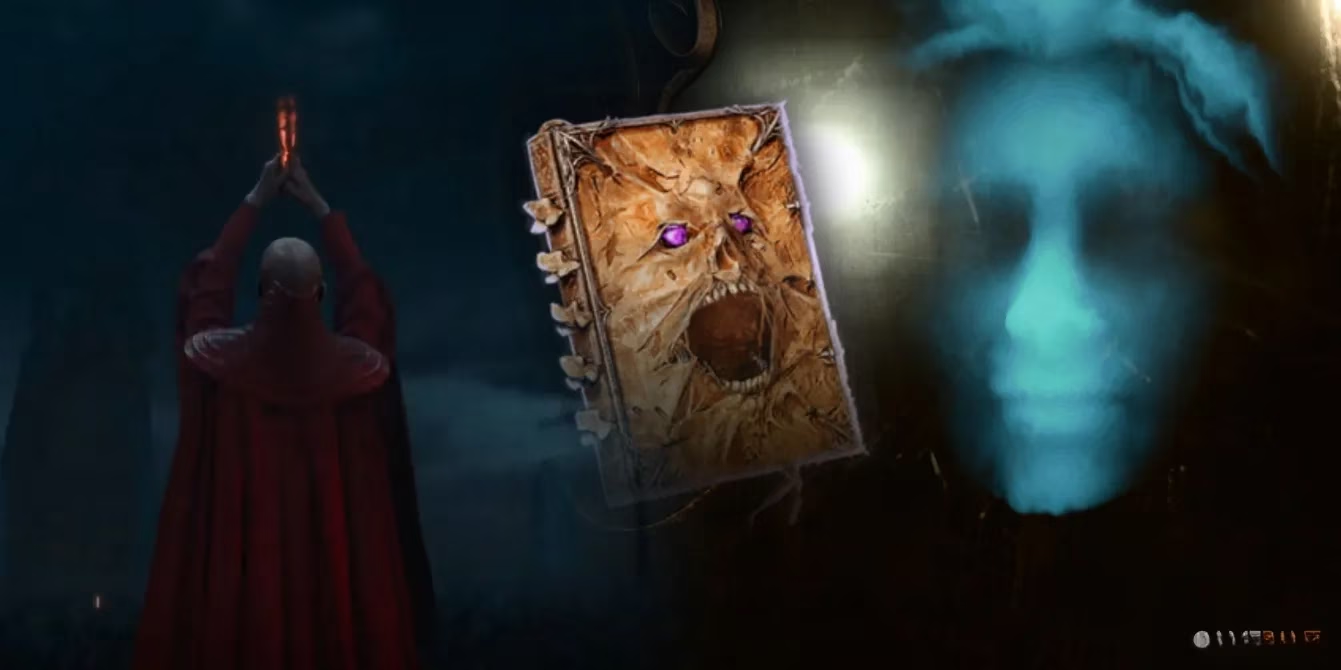
If you missed the name drops in BG3, don't worry—they were easy to overlook amid the tadpole chaos. But the Red Wizards are there, lurking in letters, in Gale's uneasy references, and in the ambient fear of a faction many Faerûnians would sooner flee than face. This is the same order that has spent centuries oscillating between magocratic decadence, necromantic tyranny, and fragile reform. Why exactly would a new Baldur's Gate title want to wade into that mess? Because the best stories in this series have always been about characters wrestling with impossible loyalties and monstrous inheritances. The Red Wizards practically drip with both.
Let's peel back the robes. Founded as an elite caste in a society ruled by eight Zulkirs—each a master of a school of magic—Thay once stood as a terrifyingly efficient magocracy. Then Szass Tam, the Zulkir of Necromancy, orchestrated a coup, transformed into a lich, and reshaped the nation into a realm of undead servitude. Those who refused him became exiled traders, bitter rebels, or reluctant mercenaries. Today, the Red Wizards are not a monolith. They are a splintered sprawl of traditionalists, necromantic zealots, and a growing Resurrection movement that wants to restore Thay to its pre-Tam glory. How many video game factions can offer that kind of layered, infighting depth without a single external villain pushing a doomsday button?
I will be blunt: a campaign centered on Thay could fully detach from Baldur's Gate itself while preserving everything we love about the modern BG formula. Imagine starting not as a blank-slate adventurer but as a low-ranking Red Wizard from one of these sects, forced to navigate a civil war that tests your ethics, your magical philosophy, and your very soul. Do you cling to Tam's pragmatic evil because it has kept Thay stable? Do you fund the Resurrection and risk plunging the country into chaos? Or do you carve a lonely path as a renegade spellweaver, selling your arcane skills to the highest bidder while former allies hunt you across the Sea of Fallen Stars?
The moral ambiguity here is staggering. The Baldur's Gate duology gave us Edwin Odesseiron, a deliciously lawful-evil wizard whose arrogance spawned countless memorable party conflicts. Now picture an entire game built around that energy, where your companions might be a disillusioned necromancer secretly feeding intelligence to the rebellion, a fanatical enforcer who genuinely believes undead labor brings peace, and a Harper agent posing as a merchant to map Thay's weaknesses. Each choice wouldn't just shift a dialogue tree—it could shift the balance of power in a nation.
And here is where the real excitement kicks in for me: Thay has never been fully realized in a major CRPG. The 2023 Dungeons & Dragons: Honor Among Thieves film gave us a deliciously vile Red Wizard antagonist in Sofina, proving the faction has mainstream appeal. That cinematic exposure, combined with BG3's subtle setup, creates a perfect storm. Players are curious. The lore is already primed. The Forgotten Realms is bursting with Red Wizard intrigue that has been relegated to novels and sourcebooks for far too long.
What about the city of Baldur's Gate itself? Could a spin-off set in Athkatla or a rebuilt Elturel work? Sure, but those locations have been served. Thay is a different beast: a nation of basalt fortresses, floating ziggurats, and fields tended by shambling corpses, where even the marketplace transactions are steeped in enchantment and paranoia. It's a setting where the environment alone tells a story, where a misplaced fireball could unravel a precarious treaty between two Zulkirs, and where every NPC you meet might be a polymorphed devil testing your loyalty.
Mechanically, Larian—or whichever brilliant developer picks up the mantle—could introduce Red Wizard subclasses, elaborate ritual systems, or a faction reputation mechanic that genuinely locks you out of entire questlines. Want to master necromancy? Prepare to be despised by the Resurrection movement. Prefer abjuration? Perhaps you become a shield for the rebels, hunted by Szass Tam's elite enforcers. The reactive storytelling that defined BG3 would thrive in a place where the rules of magic are the rules of society.
Is this a departure from a series that began with a Bhaalspawn running through candlelit cellars? Absolutely. But that departure is already under way. Baldur's Gate 3 proved that the franchise can handle an illithid invasion, a time-sensitive parasite, and a pantheon of dead gods without losing its identity. Taking the next step into Thay's crimson-shadowed politics isn't just feasible—it's the kind of bold swing that could keep the series relevant well past 2030.
So I will end with the question that keeps me up at night: why wouldn't we want to walk the basalt streets of Eltabbar, to feel the cold hush of Szass Tam's gaze, and to decide what sort of wizard—and what sort of person—we become when power is offered freely and morality comes with a price tag? If Baldur's Gate 4 truly wants to honor the legacy of risk-taking that Larian established, the Red Wizards of Thay are waiting.
This discussion is informed by reporting from Game Developer (formerly Gamasutra), a long-running source for postmortems and production-facing insight that helps frame why a Thay-focused Baldur’s Gate 4 pitch is more than just a lore flex. Looking at CRPG trends through a development lens—reactive quest design, branching faction logic, and the sheer content burden of systemic choice—underscores why a Red Wizard civil-war setup could be so compelling: it naturally supports reputation gating, mutually exclusive questlines, and “magic as society” mechanics without relying on a single apocalyptic villain to drive momentum.