The Venting Evolution: How First-Person Crawling Became a Modern Gaming Staple
Triple-A gaming embraces dynamically perspectived game design, using seamless camera shifts for immersive, cinematic gameplay experiences.
In the ever-evolving landscape of triple-A gaming, a subtle yet pervasive design choice has quietly cemented itself as a standard. It's not the ubiquitous yellow paint highlighting climbable ledges, nor the familiar animation of a hero squeezing through a narrow crack. Instead, it's the moment a character, like Star Wars Outlaws' Kay Vess, enters a ventilation shaft and simply vanishes from the player's view, the camera seamlessly transitioning to a first-person perspective. This isn't a bug or an oversight; it's a deliberate, elegant solution to a persistent spatial puzzle that has become as common in 2026 as a loot crate in a shooter.
The rationale is as practical as it is widespread. Placing a third-person camera inside a cramped, tubular vent is a recipe for visual chaos. The orbiting camera would either snag on geometry like a kite in a power line, clip grotesquely through the walls, or force developers to design comically oversized ducts just to accommodate the player's viewpoint. Swapping to first-person is the cleanest escape hatch from this dilemma. While the original Metal Gear Solid pioneered this approach back in 1998, it has blossomed into a full-blown industry trend in recent years. Games like Ghost of Tsushima adopted it for moments when Jin Sakai slithered under buildings, and Marvel's Spider-Man 2 employed it for Spider-Bot infiltration sequences. The vent crawl has become, for many developers, a pre-packaged cinematic module, a standardized piece of code that efficiently solves a recurring environmental problem.

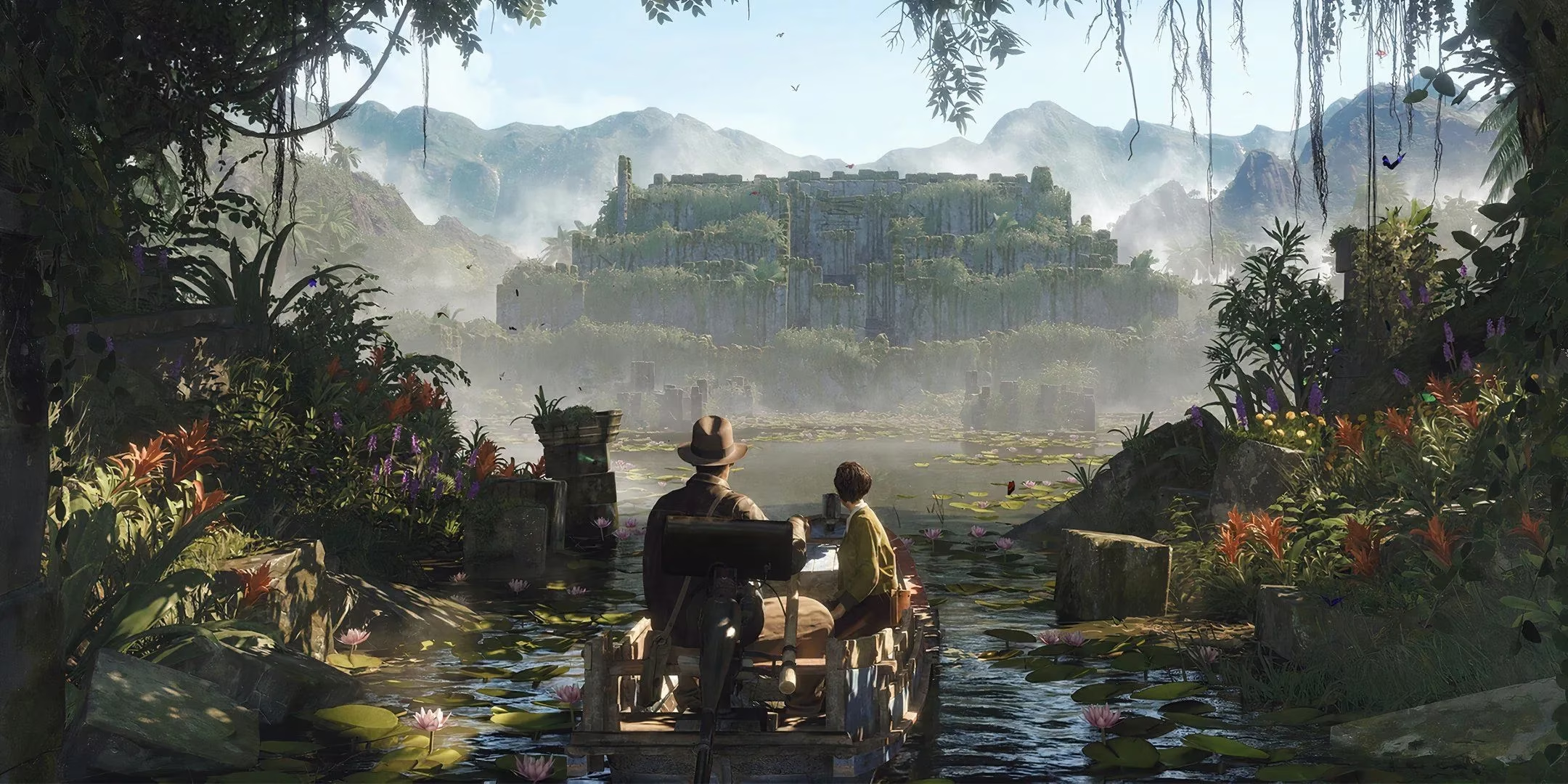
This vent-specific trick is just one symptom of a broader, more exciting shift: the rise of the dynamically perspectived game. Modern titles are increasingly treating camera angles not as rigid, defining choices, but as flexible tools to be deployed for specific gameplay moments. Indiana Jones and the Great Circle is a prime 2026 example, operating primarily in first-person for exploration and puzzle-solving but fluidly switching to third-person for the spectacle of whip-swinging and climbing—turning Indy's traversal into a rhythmic dance between intimacy and grandeur.
Baldur's Gate 3, while often remembered for its isometric roots, was a masterclass in perspective fluidity. Players could zoom out for a tactical god's-eye view, pull in tight over a character's shoulder for intimate exploration, or find any comfortable midpoint. The control scheme you chose essentially dictated your default perspective, making the experience feel uniquely tailored. This flexibility is a boon for accessibility and player preference, allowing games to mold themselves to the individual rather than forcing the player to adapt to a single, rigid viewpoint. It’s a sign of a maturing medium learning to use all the tools in its kit.
However, with great flexibility comes a new set of expectations, and therein lies the potential pitfall. When genre-defining titans like Grand Theft Auto and The Elder Scrolls offer both first and third-person modes, it can create a perception that perspective pluralism is a mandatory feature, a box that must be ticked for a game to be considered complete or modern. We saw this discourse flare up around Cyberpunk 2077's initial reveal and again with the first trailers for Indiana Jones and the Great Circle. The danger is that this wonderful new toolbox could inadvertently narrow creative horizons. If every big-budget action-adventure game starts borrowing the same "best" solutions—the vent crawl, the contextual perspective shift—we risk a homogenization of experience. The medium's vast potential could become as constricted and predictable as the very ventilation shafts that sparked this trend. A game's chosen perspective should serve its unique vision, not just follow a convenient template.
Ultimately, the first-person vent is a brilliant, small-scale innovation. It's a testament to game developers' knack for finding elegant, player-friendly fixes to technical and design challenges. Its widespread adoption shows how good ideas propagate through the industry, raising the baseline quality of moment-to-moment interaction. The broader trend of dynamic perspectives is even more promising, offering players unprecedented control over how they experience a virtual world. Yet, as we look to the future, the challenge will be to ensure these tools are used to expand creative possibilities, not to build a new, slightly more comfortable cage. The goal should be for games to feel as vast and varied as the worlds they create, not as standardized as the air ducts running through them.