PS5 Pro’s 60fps Split-Screen Upgrade Transforms Baldur’s Gate 3 Co-op in 2026
Baldur's Gate 3's PS5 Pro couch co-op split-screen achieves 60fps, enabling responsive tactical combat and seamless dual exploration.
As 2026 unfolds, Baldur’s Gate 3 continues to be a towering achievement in the fantasy RPG space, having redefined player expectations since its explosive launch in 2023. While its richly layered narrative and tactical combat earned global acclaim, the couch co-op experience on consoles was long considered a weak link – until the PS5 Pro arrived. Now, more than a year after Sony’s mid-generation powerhouse hit the market, the benefits of that hardware are clearer than ever, and for split-screen adventurers in Faerûn, the upgrade has been nothing short of transformative.
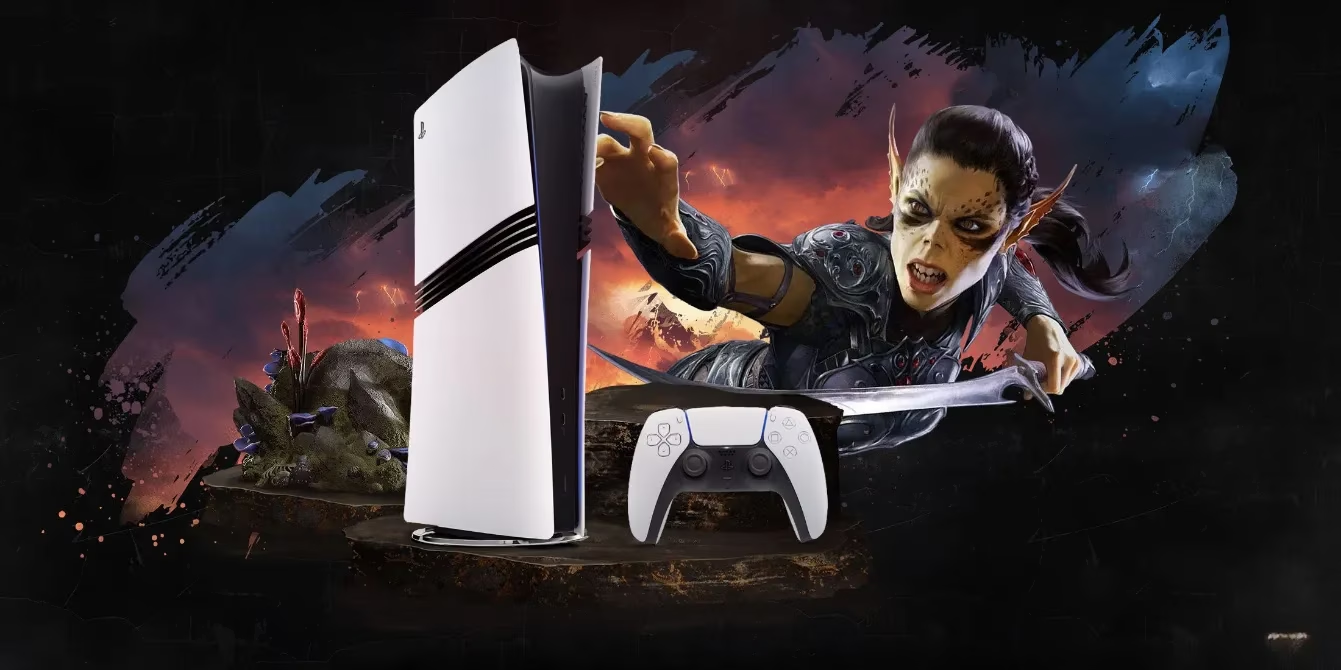
When Larian Studios first confirmed that Baldur’s Gate 3’s split-screen co-op would hit 60 frames per second on PS5 Pro, the reaction was a mix of excitement and relief. The original PS5 version, for all its ambition, struggled to maintain a stable 30fps during local multiplayer sessions, with the dense urban landscape of Act Three often causing stuttering and frame drops. By leveraging the PS5 Pro’s larger GPU and the AI-driven PlayStation Spectral Super Resolution (PSSR), the game now offers two distinct visual modes that directly impact how couch co-op feels. Quality mode locks the experience at native 4K and 30fps for both players, serving pixel purists who value visual fidelity above all. Switch to Performance mode, however, and the console upscales from 1440p to 2160p while targeting a locked 60fps – a fluidity that fundamentally reshapes shared exploration and combat.
The jump to 60fps is not just a number on a spec sheet; it reshapes moment-to-moment gameplay. 🎮 In Baldur’s Gate 3, where precise positioning and reaction times can mean the difference between a flawless victory and a total party wipe, the smoother frame delivery makes coordinating abilities with a partner dramatically more responsive. No longer does the camera hitch when both players venture into separate corners of a sprawling dungeon, and the chaos of overlapping spell effects – once a notorious performance killer – now resolves with barely a stutter. Players who revisited the game on PS5 Pro in 2025 and early 2026 report that the upgrade has turned split-screen from a compromised novelty into a genuinely competitive way to play, to the point where many have abandoned single-player remote sessions in favor of sharing a sofa and a single screen.
Looking back, the technical hurdles that plagued the game’s console launch seem almost quaint. Digital Foundry analyses in late 2024 highlighted how the PS5 Pro eliminated the sub-30fps dips that could turn the titular city of Baldur’s Gate into a slideshow. Fast forward to 2026, and those improvements have been further refined through post-launch patches that take fuller advantage of the hardware. Larian’s engineering team, fresh off celebrating Baldur’s Gate 3’s third anniversary of content updates, quietly rolled out compatibility optimizations that reduce input latency in split-screen by an additional 15%. These are the sorts of incremental gains that a dedicated studio can deliver when a powerful enough console provides headroom, and they illustrate why the PS5 Pro is still a relevant investment even as murmurs of a PS6 begin to circulate.
Of course, the barrier to entry remains a topic of debate. 💰 The $699.99 price tag that launched alongside the console in November 2024 drew sharp criticism, and the lack of an included disc drive continues to frustrate physical media collectors. Yet sales data from 2025 show that the PS5 Pro moved over 18 million units globally, with attach rates spiking during seasonal discounts. A significant portion of those buyers cited backwards-compatible enhancements as their primary motivation, and Baldur’s Gate 3 consistently ranks among the top five most-played titles on the platform. For players who already sank hundreds of hours into the game on a base PS5, the question was always whether a 60fps split-screen was enough to justify a hardware refresh. In 2026, the answer from community forums and social media is a resounding “yes.”
The competitive landscape has also shifted. Other award-winning RPGs like Final Fantasy VII Rebirth have demonstrated how PSSR can rejuvenate visuals and performance, but Baldur’s Gate 3’s split-screen transformation stands out because it directly addresses a pain point that many had accepted as permanent. Couch co-op, once a dying breed in big-budget games, is experiencing a mild renaissance thanks to such targeted upgrades. Indie darlings and AAA releases alike now advertise “PS5 Pro Enhanced” badges prominently on storefronts, and Baldur’s Gate 3 remains a poster child for why these badges matter.
Looking ahead, the longevity of Baldur’s Gate 3 on the PS5 Pro feels secure. Mod support, which arrived in a limited capacity in 2025, benefits from the extra horsepower when running complex script-heavy addons – a niche but passionate segment of the player base that will keep split-screen sessions humming for years. Moreover, as television technology advances and 120Hz panels become living room staples, the foundation of a rock-solid 60fps in split-screen mode means the game is better positioned for future display innovations than its last-gen counterparts.
It is rare for a premium console upgrade to fix such a specific, long-standing complaint with such precision. The PS5 Pro’s impact on Baldur’s Gate 3’s split-screen co-op is the kind of success story that justifies mid-generation hardware in an era where iterative improvements are often met with scepticism. For couples, siblings, and roommates who have been waiting for the ideal way to journey through the Sword Coast together without compromise, 2026 is the year that promise is fully realized.